

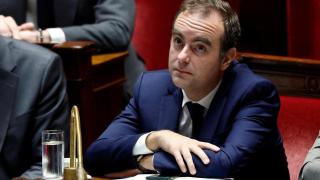

The French deputies adopted definitive los Social Security budgets for 2026which opens the door to the sequence of adoption of the general budgets for next year that the Executive expects to approve before December 31.
In total, they voted in favor of the text 247 deputiescompared to the 232 who voted against, a margin of fifteen votes, two more than those who had saved the text in first reading a week ago.
The project had been massively rejected in the Senate, where the right and the center-right have a large majority.
With a view to the general budgets
Until the last moment the suspense regarding this new vote had been maintained, because the leftist The Rebellious France had increased pressure on environmentalists to oppose the project, after having abstained in the first reading.
But in the end they maintained their first position, which allowed the prime minister, Sébastien Lecornuconfirm a victory that allows him to continue in the position, despite the fact that his immediate future remains subject to many uncertainties.
The head of the Government had to make many concessions to the socialists, in particular the suspension of the reform of pensions adopted in 2023 that delayed the minimum retirement age by two years.
These measures generated division within the Macronist coalition and they raised the planned expenditure by about 5 billion euros, which jeopardizes the commitment to place the public deficit at 5% that Paris had acquired with Brussels to return it to 3% in 2029.
Lecornu must now find agreements to adopt the general state budgets before the end of the year, a task that does not seem easy.
The deputies rejected at first reading the initial project, which, however, was adopted by the Senate. A mixed commission of both chambers must meet this Friday to agree on a text that should be voted on the following week.
It seems so difficult to achieve an acceptable compromise, that every day there are more voices asking Lecornu to use the constitutional mechanism that allows him to adopt budgets without a parliamentary vote.
Something that the prime minister promised to renounce to give priority to the parliamentary negotiation, but which he can resort to if a majority project does not emerge from it.
In case of adopt non-voting accountsthe opposition can present a motion of censure, the result of which would be very delicate for a Lecornu who lacks a majority in the lower house.
He could thus suffer the same fate as his last two predecessors, the conservative Michel Barnier, who lost a vote of no confidence in December 2024 after just three months in office, and the centrist François Bayrou, who fell in a vote of confidence last September.