

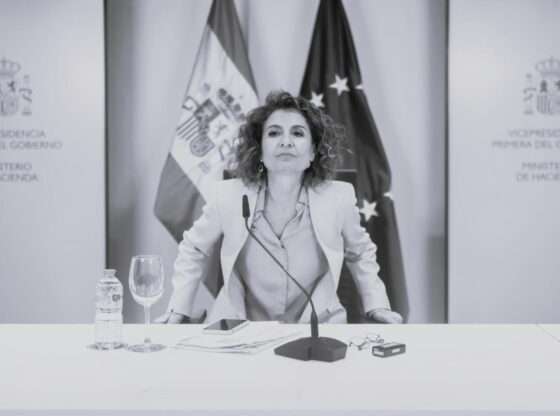

The political praxis of the current Spanish social-communist coalition government in budgetary matters reveals, indisputably, an ominous disregard for the basic principles of a liberal democracy.
Far from being a mere technical mismatch, a temporary arithmetic difficulty or something exceptional, the systematic absence of the General State Budgets (PGE) since 2022 has become common in Spain when it constitutes a profound institutional abnormality, unprecedented in any European state, which reveals the only real objective of the government coalition: to remain in power at any price, subverting the spirit of the constitutional order.
In this context, the rejection by the Congress of Deputies of the path of stability proposed by the communist social Executive for the years 2026, 2027 and 2028 is the last and irrefutable proof of the absence of a parliamentary majority that supports the economic projects of the Executive.
This highlights the government’s inability to approve any significant law and constitutes a textbook case of a Cabinet that has lost, de facto, its ability to govern.
Faced with this panorama, Brussels cannot remain silent or look the other way. The composition of Parliament turns the budgetary objectives sent by the Spanish Government to the European Commission into an unviable phantasmagoria for a simple reason: it lacks the necessary support to meet them. But the story doesn’t end there.
The rejection of the deficit path highlights the government’s inability to approve any significant law
Without General State Budgets, a Government lacks any moral legitimacy to develop its own fiscal and budgetary strategy.
In the canon of the architecture of a parliamentary system, the PGE are not a simple collection of figures; They are the supreme legal act of economic policy and the foundation on which the Legislative Power exercises its essential and foundational prerogative: the control and supervision of public expenditure and income.
Governing with systematically extended accounts is the consecration of a structural subversion that empties the principle of budgetary legality of its content. It is the institutional euthanasia of the democratic oversight of public accounts.
This situation is not an accident, but a necessity imposed by the government’s inability to forge a parliamentary majority, even temporary, for the approval of any Budget.
Faced with this structural weakness, the Executive has designed a pernicious modus operandi to spend without control, combining and perverting three mechanisms: the automatic budget extension that establishes the base spending ceiling; the abuse of the figure of the Decree-Law, forcing the variation of priorities and the approval of new expenses without due debate and the instrumental use of Extraordinary Credits and Credit Supplements, the exercise of which has been distorted to increase items in a discretionary and opaque manner, and operate with a financial freedom typical of an exceptional regime.
The systematic use of these figures constitutes the key to the pathological behavior of the social communist Cabinet: the conscious annulment of the founding principle of liberal democracy, that is, the effective control of public finances by Parliament.
This translates into a progressive and irreversible erosion of the legitimacy of the exercise of the Government. The legitimacy of origin, obtained at the polls, is insufficient and fades if it is not based on the rigorous observance of essential legal and constitutional procedures, in this case, those related to the budgetary sphere.
In a parliamentary regime, the Government needs, pardon the redundancy, the confidence of Parliament to govern. The State Budget is the most important financial law and when it is rejected by the Legislature the reading is clear: the Executive has lost the support of the majority necessary to carry out its program.
The legitimacy obtained at the polls is insufficient and fades if it is not based on rigorous observance of essential legal and constitutional procedures.
In practice, in almost all Western democracies, the materialization of a scenario of this nature leads to the fall of the Government, which is usually formalized by presenting a question of confidence, a motion of censure or, simply, calling early elections.
A Government that, out of purely venal and survival calculations, renounces having its budget plans approved by Parliament and ignores its rejection by it, lacks any legitimacy to direct the destinies of the nation.
Consequently, entrenching oneself in power when that happens is not only a lack of respect for the popular sovereignty that it permanently invokes, but it shows once again its willingness to ignore and violate the system of checks and balances that define liberal democracy.
In the field of public finances, as in many others, the social-communist coalition has de facto consummated a constitutional mutation, replacing the procedures of parliamentary democracy with Caesarist emergency management.
The renunciation of the Budget, an act of sovereignty par excellence, is the final confession of an Executive that has degraded its function to that of a mere administrator of its own survival. His behavior constitutes irrefutable proof of the loss of all legitimacy to continue directing the destinies of a free, modern and civilized nation.